
Comparison of Advantages and Disadvantages of Traditional Plastic and Organic Glass Display Boards
Plastic display boards and organic glass (acrylic) display boards are the two mainstream materials for store display, product presentation and advertising signage. Many merchants struggle to choose between cost performance and display effect and fail to clarify the applicable scenarios of the two materials. This article comprehensively analyzes the core advantages and disadvantages of traditional plastic and organic glass display boards, helping enterprises select materials accurately to meet diverse business and display needs.
Traditional plastic display boards are mostly made of PVC, PP and ordinary PET, with cost performance as their core advantage. Featuring low raw material cost and simple processing technology, they can be quickly cut and shaped without complicated follow-up procedures, making them suitable for mass customized procurement. Lightweight and flexible, these boards are slightly bendable and shatterproof during transportation, which greatly reduces logistics loss and replacement costs. They are ideal for short-term scenarios such as temporary promotions, stall displays, price tagging and event signage with low-frequency and short-term usage demands.
However, traditional plastic display boards have obvious drawbacks. They deliver poor light transmittance with a frosted translucent appearance, resulting in a low-grade visual effect that fails to highlight product quality. The soft surface is prone to scratches and creases. After long-term placement, they tend to turn yellow and curl up with poor weather resistance, and will age and become brittle rapidly under outdoor sunlight exposure. Limited by processing performance, they cannot be finely polished or specially carved with rough cut edges. Besides, their weak printing adhesion easily causes paint fading, making them unqualified for high-end display scenarios.
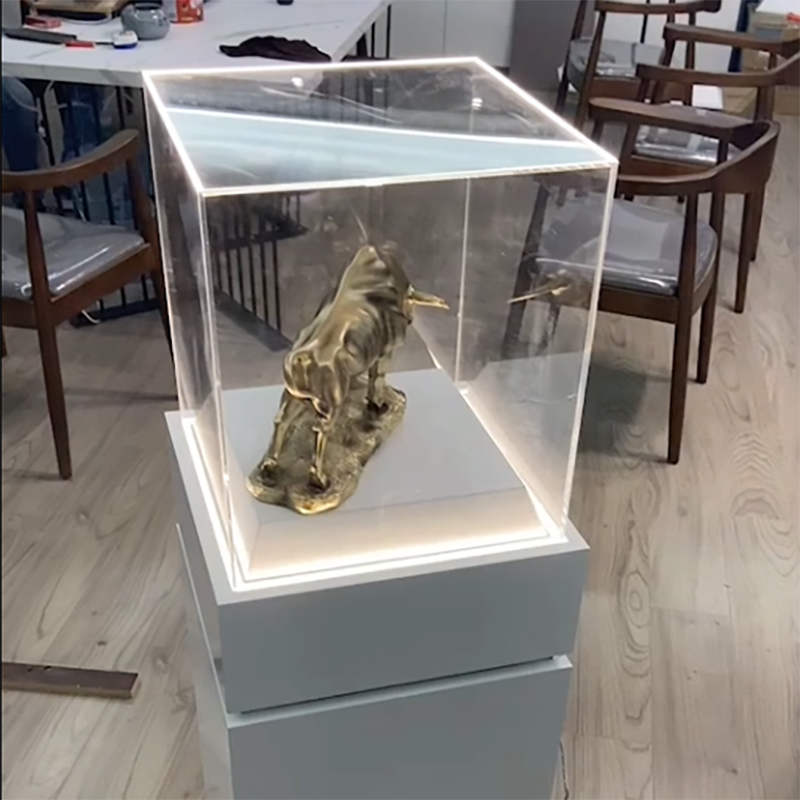
Organic glass (acrylic) display boards are the preferred material for high-end display scenarios. With a light transmittance of over 92%, they are as transparent and clear as glass, delivering a premium display texture and effectively upgrading the grade of products and store brands. Boasting excellent toughness and impact resistance, they are hard to break and far safer than ordinary glass and thin plastics. They support laser cutting, precision carving, hot bending forming and mirror polishing with smooth and transparent edges. Various special-shaped customizations are available, perfectly adapting to long-term display scenarios for ornaments, boutique products and exhibitions.
In addition, high-quality acrylic features outstanding weather resistance and UV resistance, resisting yellowing and fading. It can remain bright and clean after long-term indoor and outdoor placement, with a service life several times longer than ordinary plastic. Its only shortcomings are higher raw material and processing costs, as well as vulnerability to hard object scratches which requires daily protection.
In conclusion, traditional plastic display boards are suitable for short-term and low-cost display demands, while organic glass display boards are the priority for high-end texture, long-term reuse and brand display. Reasonable material selection can balance display effect and cost perfectly.
 No agent has been added~